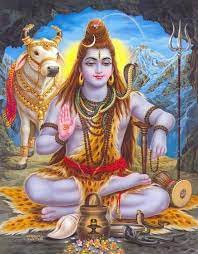
ORIGIN: Hindu
TYPE: Principal creative and destructive god.
KNOWN PERIOD OF WORSHIP: Circa 300 BCE, and probably earlier as Rudra, until present.
SYNONYMS: Accredited with more than a thousand epithets in Hindu writings (See also Bhairava, Khandoba).
CENTER(S) OF CULT: Benares, etc.
ART REFERENCES: Sculptures generally in bronze, but also in stone, reliefs.
LITERARY SOURCES: Ramayana epic and Puranic Texts
INFORMATION: Siva is a deity with the linked roles of both creator and destroyer of life, more generally the latter. He personifies the inexorable passage of time and out of destruction he creates new life. He may have evolved from the Vedic storm god Rudra, though he is now thought to be an older Pre-Indo-European deity whose attributes appear on seals from the Indus Valley civilization. His consort, or more precisely his female aspect, is Sakti, but he is also closely linked with the terrible Kali and the goddess Sati.
He is generally depicted in the role of an ascetic with a blue painted throat, attributed to holding the primal poison halahala in his throat before swallowing it to save mankind from its deadly effect. His sacred animal is the bull Nandi. He bears four arms (less commonly than two) that hold a variety of attributes including a bow, a club to which is fastened a skull, a drum (damaru), representing the rhythm of creation, and a noose. He has a strong association with fire and may hold a ball of flame—the destructive corollary to creation. His symbol is the linga (phallus), often accompanied by the femal yoni and these objects in stone may form the focus of worship.
The Saivite sect envisages Siva as a creator, preserver, and destroyer and he is manifest in three aspects of his own divine power. As the ascetic, represented by the Yogi, he is in his destructive aspect. His consorts are Kali and Durga. He destroys without emotion. The Yogi is naked, smeared with ashes and with matted hair, sitting under a banyan tree holding a beggar's bowl. As the "lord of the dance", Nataraja, Siva's steps follow the rhythm of the universal forces. He dances in a circle of fire, treading upon the dwarfish figure who is the personification of ignorance (see also Vamana). In this aspect he can be drawn as a jolly figure, a drinker of wine and a hunter. As the linga the form of Siva that devotees generally worship, he is the symbol of creative powers. In his cosmic capacity he appears as Nataraja.
Legend has it that Sival lives in Kailas, a place beyond the Himalaya. The Lingayats, a particular Saivite sect founded in the twelfth century CE, may carry a small stone linga mounted in a silver box and worn round the neck or arm. Chiefly centered on southern India, sanctuaries to Siva are often homes to devadasis, troupes of dancing girls who also server as cultic prostitutes. Siva also enjoys popular worship as a domestic deity. See also Pancanana.